Dirt Isn't Just Dirt
One of the biggest misconceptions I hear from homeowners is, "It's just dirt."
After more than 20 years in excavation, I can tell you that's one of the most expensive assumptions you can make.
The success of nearly every excavation project — whether it's a drainage system, driveway, building pad, or yard grading project — depends on understanding what's already beneath your feet before the first bucket of soil is moved.
Understanding a property's soil is one of the first things I evaluate before recommending any excavation work. Every soil type has strengths, weaknesses, and a purpose. Knowing those differences helps ensure a project lasts for years instead of becoming an expensive repair.
Every Property Tells a Different Story
If you've lived in Middle Tennessee very long, you've probably noticed how much the landscape changes.
- Rolling hills.
- Limestone ridges.
- Creek bottoms.
- Open farmland.
- Wooded hillsides.
Those landscape changes usually mean the soil changes too.
Even neighboring properties can have completely different soil conditions depending on elevation, drainage patterns, previous construction, and decades of natural erosion.
That's why I never assume one solution fits every property.
Good excavation starts by understanding the site — not by moving dirt.
Middle Tennessee Clay: Better Than Its Reputation
Many homeowners hear the word clay and immediately think something is wrong because their yard is soggy.
The truth is, clay isn't the enemy.
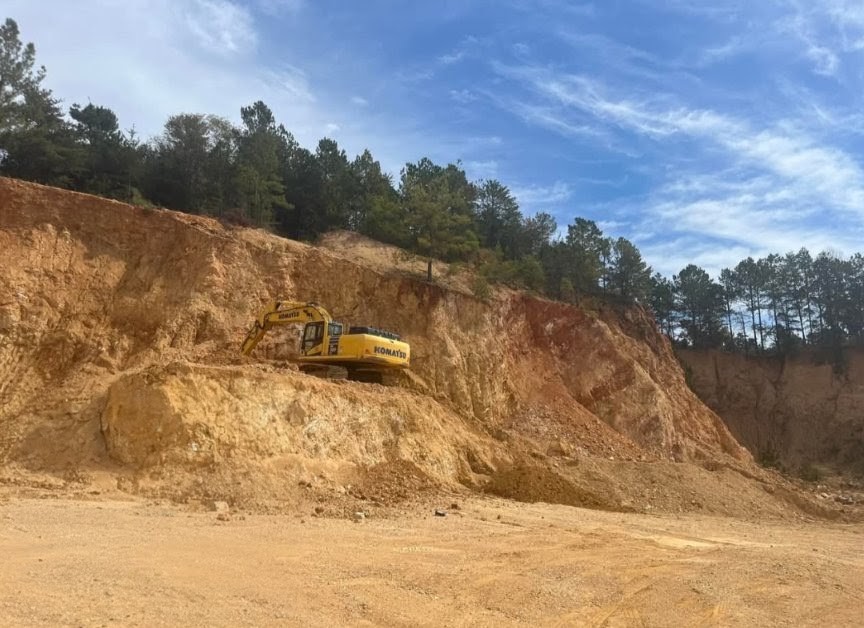
In fact, much of Middle Tennessee is built on clay-rich soils, and those soils can perform extremely well when they're understood and managed correctly. You won't find the same widespread glacially deposited soils here that are common farther north. Many Middle Tennessee soils developed from weathered limestone and other local parent materials, and clay-rich layers can hold moisture and release it slowly.
Clay particles are incredibly small, allowing them to hold significant amounts of water. Water can move through clay, but much more slowly than it moves through sand or gravel. After a heavy rain, that slow movement often means clay stays wet longer than other soil types.
When clay becomes saturated, some types expand. As they dry, they may shrink and develop surface cracks. This natural cycle is one reason grading and drainage are so important around homes.
One thing many homeowners don't realize is that Middle Tennessee clay often contains enough organic material and nutrients to support healthy lawns without importing large amounts of topsoil. While quality topsoil is always beneficial in certain situations, exposing clay during grading doesn't automatically mean your yard has been ruined.
Proper grading, healthy seed, and good moisture management usually matter much more than people expect.
Topsoil Is More Valuable Than Most People Think
Topsoil is the upper layer of soil where most plant roots live.
It's rich in organic matter, nutrients, microorganisms, and biological activity that help support healthy vegetation.
Unlike the clay beneath it, topsoil generally erodes more easily. That does not mean clay won't erode — unprotected clay can erode badly too.
That's why construction projects should disturb only what's necessary and stabilize exposed soil as quickly as practical.
One interesting thing I've noticed over the years is that some of the best topsoil naturally collects in lower portions of a property. Gravity, rainfall, leaves, and organic material all work together over many years to slowly move nutrients downhill.
Nature is constantly reshaping the landscape.
Chert: One of Middle Tennessee's Signature Materials
If you've spent much time around excavation in Tennessee, you've probably heard someone say they hit "chert."
Chert is a naturally occurring rock commonly found throughout Middle Tennessee. It formed millions of years ago and is often associated with our limestone geology.
Not all chert is created equal.
Some pits produce cleaner material with very little clay. Other sources contain much more clay mixed throughout.
Good driveway chert almost acts like a natural crusher run. It contains a blend of larger rock, smaller stone, and fine material that compacts into a durable driving surface.
Higher-clay chert can often work well for structural fill and building pads because it compacts tightly when installed under the right conditions.
Knowing where material comes from matters almost as much as knowing how to use it.
Every Aggregate Has a Purpose
One of the biggest misconceptions I see is homeowners assuming all gravel is basically the same.
It isn't.
Different aggregates are designed for completely different jobs.
Using the wrong material often leads to unnecessary repairs later.
#57 Stone
#57 stone is one of the most common aggregates used in residential construction.
It's a washed limestone product that averages about ¾ inch in size and contains very few fine particles.
Because the fines have been removed, water flows easily through it.
That's exactly why it's commonly used around foundation drains, French drains, concrete slabs, and other applications where drainage matters.
It also "locks together" surprisingly well despite lacking fines, making it a stable base beneath many concrete installations.
However, that same characteristic makes it a poor choice for steep driveways or areas exposed to concentrated flowing water.
If water gains enough speed, it can carry #57 stone away.
Crusher Run
Crusher run looks very different.
Instead of being washed, it contains a mixture of crushed stone and limestone fines.
Those fines are what make crusher run such an excellent driveway material.
When properly compacted with the right moisture content, the particles lock tightly together to create a durable driving surface.
That's why crusher run is commonly used for:
- Residential driveways
- Parking areas
- Base layers beneath pavement
- Access roads
Unlike #57 stone, crusher run is designed for strength — not drainage.
Proper crowning is still important because even the best driveway material performs poorly if water is allowed to sit on it.
1½-Inch Stone
Larger stone also has its place.
In some high-volume drainage applications, I prefer using 1½-inch stone because the larger void spaces allow water to move more freely than smaller aggregates.
It's also useful around certain drainage outlets where additional energy dissipation is needed before water enters a ditch or natural drainageway.
Again, there's no universal "best" stone.
There's only the right material for a specific job.
Riprap
Riprap is designed for one purpose:
Controlling erosion.
These larger stones are commonly installed along creek banks, drainage channels, culvert outlets, and steep slopes where flowing water has enough force to move soil.
The amount of water determines the size of riprap required.
I've personally seen flowing water move six-inch rock.
That's why properly sizing riprap matters.
Whenever practical, I also prefer installing geotextile fabric beneath riprap. It helps separate soil from stone, improves long-term stability, reduces vegetation growing through the rock, and helps limit soil migration underneath.
Compaction Matters More Than Most People Realize
One of the most overlooked parts of excavation isn't the material itself.
It's how that material is installed.
Proper compaction removes excess air pockets and creates a more stable surface capable of supporting weight over time.
Without proper compaction, even quality material can settle unevenly.
That's why simply dumping gravel into an area rarely produces lasting results.
Moisture content, lift thickness, equipment, and soil type all influence how well material compacts.
Good excavation isn't just about moving dirt.
It's about building stable ground.
Common Mistakes I See
Over the years, I've noticed several mistakes that repeat themselves.
- Assuming all gravel performs the same.
- Ignoring how water naturally moves across a property.
- Choosing material based only on price.
- Skipping proper compaction.
- Thinking every property should be treated the same.
Most of these mistakes don't become obvious immediately.
They show up months — or even years — later.
From the Field
One thing excavation has taught me is that Mother Nature always wins.
Water follows gravity.
Soil responds differently depending on its composition.
Every property has its own strengths and challenges.
My job isn't to force every property into the same solution.
My job is to understand what the land is already telling me and work with it — not against it.
That's usually the difference between a project that lasts for decades and one that needs to be repaired after the next few heavy rains.