Why Flow Rate Matters
One of the first things I determine when evaluating a drainage problem is how quickly water may be reaching the area during a heavy rain.
A small puddle can be misleading. Several thousand square feet of roof, driveway, lawn, or hillside can produce more than 100 gallons per minute of runoff. Larger areas can produce well over 1,000 gallons per minute.
Before choosing a catch basin, French drain, pipe size, or outlet, it helps to understand the flow rate the system may need to handle.
Start With the Contributing Area
I begin by looking at the rooflines, downspouts, surrounding slopes, and the high points of the property. The goal is to identify the entire area draining toward one location.
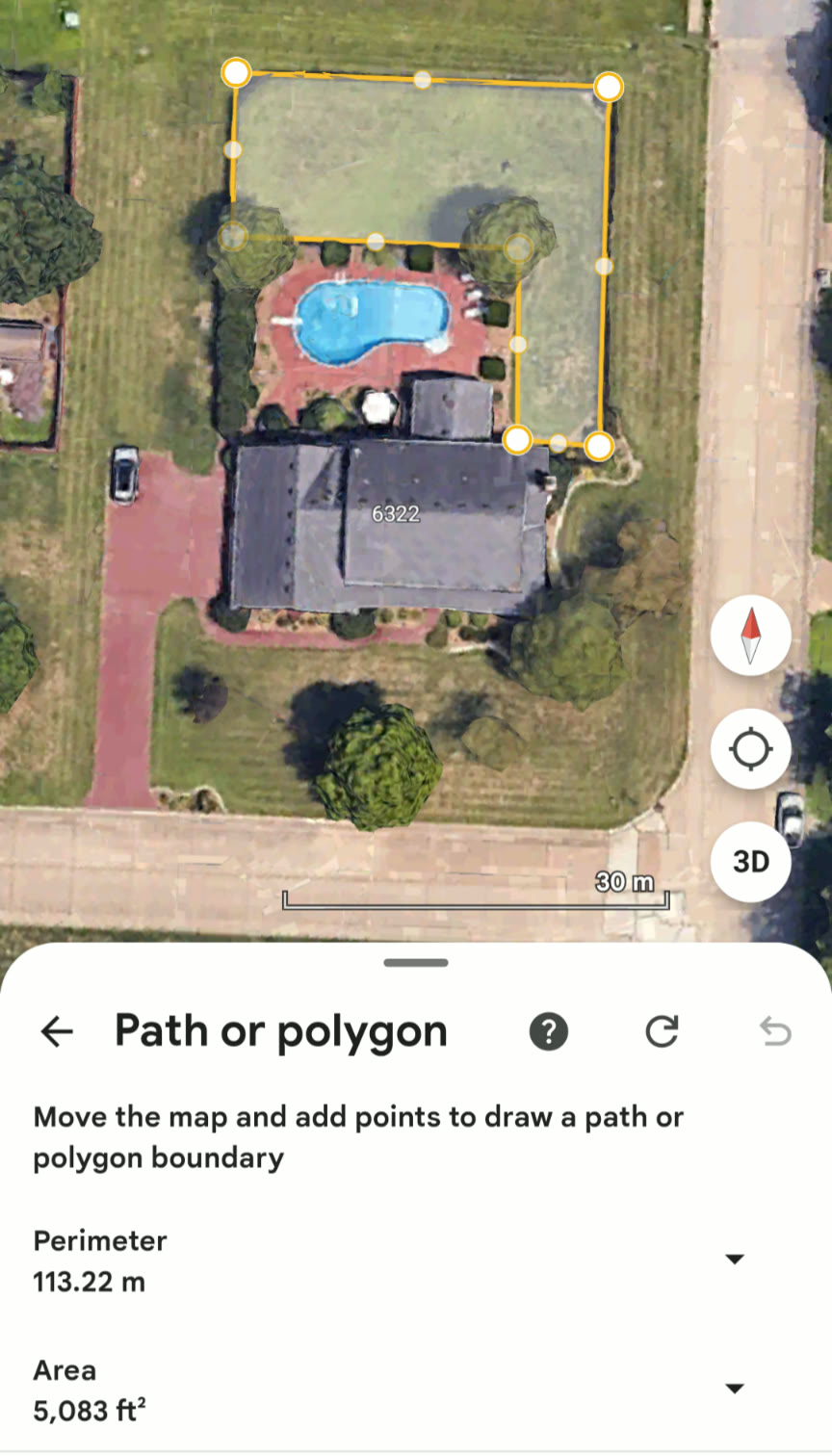
Google Earth can provide a useful square-footage estimate. Draw a polygon around the contributing area, then use that measurement in the runoff formula.
Include all areas that may contribute water:
- Roofs
- Driveways and parking areas
- Patios
- Lawns
- Hillsides
- Runoff entering from adjoining property
A roof or paved surface has almost no absorption. Vegetated ground may absorb some water when it is dry, but once Middle Tennessee clay becomes saturated, that absorption drops sharply.
For a conservative field estimate, I may assume little to no infiltration once the ground is heavily saturated rather than count on the soil absorbing part of the storm.
Estimating Stormwater Flow Rate
To estimate runoff in gallons per minute:
This is a practical, conservative field estimate of runoff flow rate. Engineered stormwater design may also account for factors such as time of concentration, site-specific rainfall data, and more detailed hydrologic conditions.
Where:
- Area is measured in square feet.
- Rainfall intensity is measured in inches per hour.
- 0.623 is the number of gallons produced by one inch of rain falling on one square foot.
- Runoff coefficient estimates how much rainfall becomes runoff.
A runoff coefficient of 1.0 assumes 100% runoff.
For a conservative estimate during a heavy rain on saturated ground, using 1.0 provides a useful worst-case number.
A Quick Shortcut for a Two-Inch-Per-Hour Rain
For a two-inch-per-hour rainfall with nearly 100% runoff, multiply the contributing square footage by 2.1%:
This shortcut comes very close to the full formula and makes field estimating easier.
Example 1: Residential Property
Google Earth measured the contributing backyard area at 5,083 square feet.
Using the full formula:
Using the quick shortcut:
The shortcut differs by only about one gallon per minute.
That means this ordinary residential area could send more than 100 gallons per minute toward one low point during a two-inch-per-hour rain.
Example 2: Large Ball Field Area
The measured contributing area around a ball field was 81,876 square feet.
Using the full formula:
Using the quick shortcut:
The two answers are within approximately 1% of each other.
This example shows how quickly runoff flow rate increases when a large area drains toward one location.
Pipe Diameter Is Only Part of the Calculation
Knowing the estimated runoff flow rate does not automatically tell you which pipe to install.
Pipe capacity also depends on:
- Available slope
- Pipe material
- Number of fittings
- Inlet capacity
- Outlet design
- Whether sediment or debris can enter
- The smallest opening anywhere in the system
Manufacturer flow ratings can vary dramatically depending on pipe slope. A maximum rating may assume much more fall than is available in a nearly flat residential yard.
Many drainage systems I install operate near a 1% slope, so I use conservative expectations rather than relying on a maximum advertised capacity.
A four-inch pipe connected through a three-inch fitting is restricted by that three-inch opening. The same is true when a popup emitter or outlet is smaller than the pipe feeding it.
Multiple 90-degree fittings can also reduce flow. Every part of the system — from the inlet to the final discharge — must be considered together.
Water can rise through the final elbow beneath a popup emitter as long as the emitter remains lower than the system's entrance elevation. Gravity is based on the difference between the starting and ending elevations, not whether every section of pipe travels continuously downward.
Field Note
The Main Lesson
Before selecting a drainage product, calculate the approximate runoff flow rate reaching the area.
Then evaluate the complete path:
A large pipe cannot make up for an undersized catch basin connection, a restricted emitter, poor slope, or an outlet that cannot release the water safely.
This calculation is a practical field estimate of runoff flow rate—not a substitute for engineered stormwater design on large, complex, or regulated projects—but it gives homeowners a much clearer understanding of how quickly water may be moving across their property.